

31
Mar
13:00
Lorem ipsum dolor sit amet consectetur. Aliquam pellentesque et vel fames id nunc gravida et.
Industrial companies rely on an ERP system to centrally manage, automate, and optimize their business-critical processes. While ERP systems generate and store large amounts of data, they often offer limited capabilities for data analysis and cannot directly integrate data from other systems. Manually creating reports—for example in Excel—is time-consuming and does not reflect data in real time.
A modern data analytics infrastructure (MS Fabric, Modern Data Warehouse) facilitates the automated preparation and integration of data from various sources, completely eliminating manual workflows.
Interactive dashboards enable tailored, real-time reporting. This drives significant efficiency gains: a Single Source of Truth, the elimination of data silos and Excel spreadsheets, and insights at the click of a button.

We are an official Microsoft Data & AI Solutions Partner

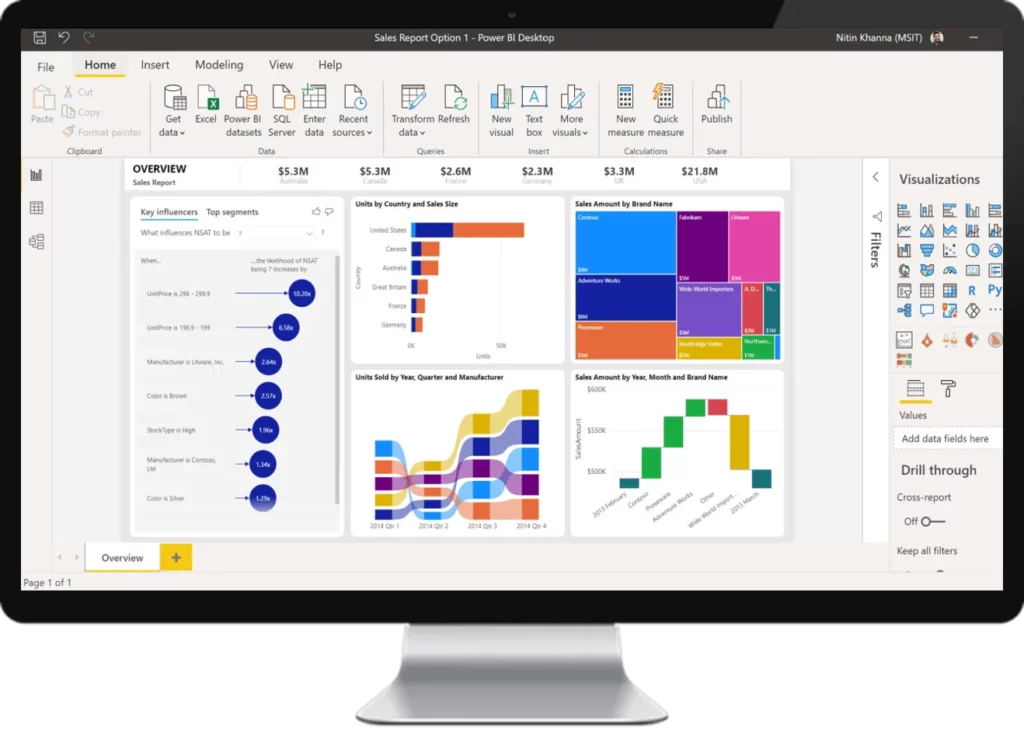
As part of the Microsoft product ecosystem, Power BI as a leading business intelligence solution can be seamlessly integrated into your existing Microsoft environment. Interactive reports can be shared flexibly via Teams, SharePoint, PowerPoint, etc., while existing workflows remain unchanged.
Industrial companies require an ERP system like Microsoft Dynamics (Dynamics 365 Business Central, Finance & Supply Chain Management) or SAP to centrally manage, automate, and streamline their business-critical operations. These systems provide structure, efficiency, and transparency across complex workflows.
However, ERP platforms are fundamentally built to execute and standardize transactions, not to analyze data. They frequently lack the flexibility and usability required for deep data analytics and comprehensive reporting. Modern Business Intelligence tools like Microsoft Power BI bridge this gap, enabling organizations to extract valuable insights from their ERP data (Self-Service BI) and visualize them in an intuitive, user-friendly format.

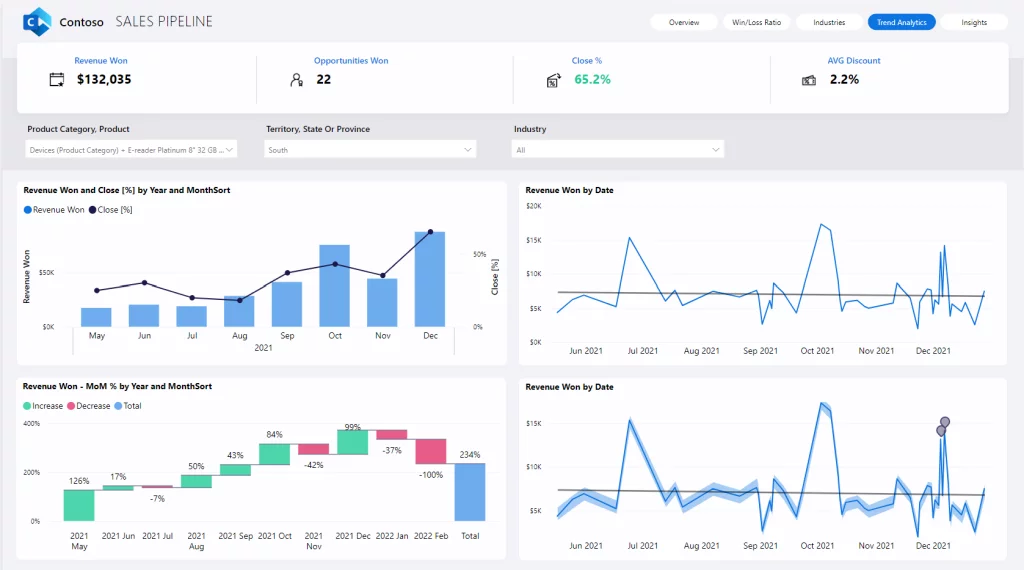
A clean data foundation and high data quality form the basis for deploying AI algorithms and Generative AI, such as intelligent chatbots (Microsoft Copilot). AI-driven analytics make it possible to identify patterns in the data, enabling trend forecasting (Predictive Analytics, Machine Learning, Anomaly Detection, AI Document Processing). Generative AI facilitates process automation and the creation of new content. Furthermore, with a robust data infrastructure and strict Data Governance, numerous repetitive tasks can be automated (Workflow Automation).

Analysis of the existing infrastructure, prerequisites, and requirements.
Analysis of data sources and integration possibilities.
Definition of the displayed data and its presentation, as well as the design concept.
Creation of the designed reports with varying access permissions, as needed.
Introduction to the functionalities for consuming the reports, and training of key users in developing and customizing reports.
Feedback loop for adjusting the developed reports
In today’s digital world, data is the foundation of successful organizations. While many companies already collect data, untapped potential often remains in how it is organized and analyzed. A targeted data architecture fully unlocks this potential.
A comprehensive data architecture includes:
This includes not only physical storage solutions but also cloud resources, business applications, business intelligence and analytics tools such as Microsoft Power BI, as well as a well-thought-out data strategy, clear guidelines, and qualified personnel. The harmonious interaction of these components is crucial for a successful, data-driven digital transformation.
Our guiding principle is: “As simple as possible, as complex as necessary.”
Management often needs efficient and interactive dashboards to make data-driven decisions. But what steps are required to implement these functionalities?
Depending on the maturity, complexity, and ambitions of your organization, we design the data architecture to fit precisely. Whether it’s direct integration with your management system, the use of a data lake, building a data warehouse (DWH), or providing specific data marts – we jointly evaluate the advantages and disadvantages and efficiently implement the optimal components.
We support organizations as an external partner in building, developing, maintaining, and optimally using their data infrastructure. In doing so, we ensure that our clients’ individual requirements and strategic goals are always at the center. Through tailored solutions and customized technologies, we enable the full potential of your data to be realized.
We are an official Microsoft Data & AI Solutions Partner. In addition to our extensive expertise in data architecture projects, we bring deep knowledge in the analytics field. We leverage this expertise to create data architectures that meet not only current but also future analytics needs – efficiently, scalably, and future-proof.



Seilerstrasse 4
3011 Bern
Badenerstrasse 120
8004 Zürich
Subscribe to our newsletter for the latest updates on real estate investments.