
Weather adjustment for greater comparability of KPIs
In the wake of increasing regulatory requirements and growing expectations from investors and regulatory provisions, ESG reporting is becoming ever more relevant for real estate players. A key element of this is the transparent reporting of energy consumption, which is broken down into electricity and thermal energy. Anyone who wants to properly analyze energy consumption in real estate portfolios and correctly present developments over time cannot avoid one topic: weather adjustment.

Why a weather adjustment is necessary
The energy consumption of a building depends not only on its efficiency or the renovation measures implemented, but also to a large extent on the weather. A harsh winter causes consumption to rise, regardless of technical improvements. A mild winter, on the other hand, can exaggerate efficiency gains. This poses a challenge for ESG managers who publish annual energy KPIs: Only if weather influences are mathematically removed from the data can consumption figures be compared over several years. In a cold winter, the heating requirement is naturally higher than in a mild one. Studies show that heat consumption can fluctuate by up to 8% per degree Celsius difference. Without weather adjustment, the comparison with the previous year can lead to misinterpretations; efficiency gains remain undetected or measures appear more effective than they are.
The REIDA methodology has become established for the calculation of environmentally relevant key figures as defined by AMAS (and adopted by KGAST and ASIP). Among other things, REIDA also defines standards for weather adjustment.
The calculation process at a glance
The energy consumption is adjusted in several steps. Both individual building characteristics and regional weather data are taken into account.
1. collection of basic data
First of all, clean basic data must be available:
- Thermal energy consumption per property, ideally divided into heating and hot water
- Address data of the property: this is central to the geographical allocation.
- The energy reference area per property
- Ideally, the degree of utilization of the heating system in the property (or assumption for the corresponding energy source according to REIDA methodology)
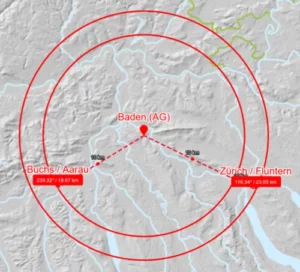
2. assignment of the property to a measuring station for determining the outside temperature
The next step is to assign it to an official measuring station. According to SIA standard 2028:2010, around 40 quality-assured weather stations are available in Switzerland. The decisive factor here is:
- The shortest possible distance to the property
- an altitude difference of less than 200 m to avoid climatic distortions.
3. determination of the building-specific base temperature
The base temperature is the threshold value above which a building must be heated in order to maintain a comfortable indoor temperature. This temperature is an approximate value and is calculated individually. It depends on the energy status of the property. Influencing factors are
- Heating consumption (total energy consumption minus energy for hot water production)
- Efficiency of the heating system
- Energy reference surface (ERS)
The base temperature forms the basis for the subsequent determination of the heating degree days.
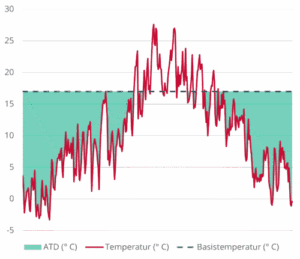
4. calculation of the current accumulated temperature difference (ATD)
The so-called accumulated temperature difference ATD (SIA 380:2022; Appendix F) indicates how much and how long heating was required in a period. The difference between the base temperature and the actual daily outside temperatures is calculated for this purpose. Positive differences are added together – the greater the sum, the more heating was required in the respective reporting period.
5. comparison with a reference period
A reference ATD is calculated in order to place the current weather situation in a comparable long-term context. This refers to the average temperature over a certain period of time. This ensures that the result is independent of short-term weather influences.
6. adjustment of the heating requirement
The correction is now made using ratio ATD:
- Ratio ATD = reference ATD / current ATD
This factor is applied to the heating consumption. This produces a weather-adjusted consumption value that is independent of climatic fluctuations. Hot water consumption is not adjusted, as it is largely independent of the outside temperature. It is added back to the adjusted heating consumption at the end.
Extended areas of application
The logic of weather adjustment can be applied to other energy issues. Cooling energy is also subject to climatic fluctuations, but in the opposite direction: the warmer the summer, the higher the cooling demand. An ATD-based adjustment can help to neutralize climate fluctuations. The same applies to the production of solar power, the yield of which is heavily dependent on solar radiation. Standardization makes yields more comparable.
Conclusion: A must for every ESG data strategy
The weather adjustment is far more than just a methodical gimmick. It is a key element for reliable, transparent and comparable ESG reporting. Only when climatic effects are factored out can developments over time be analyzed truthfully and portfolios or properties compared with one another.
The REIDA methodology provides a proven and transparent standard that is increasingly gaining acceptance.